
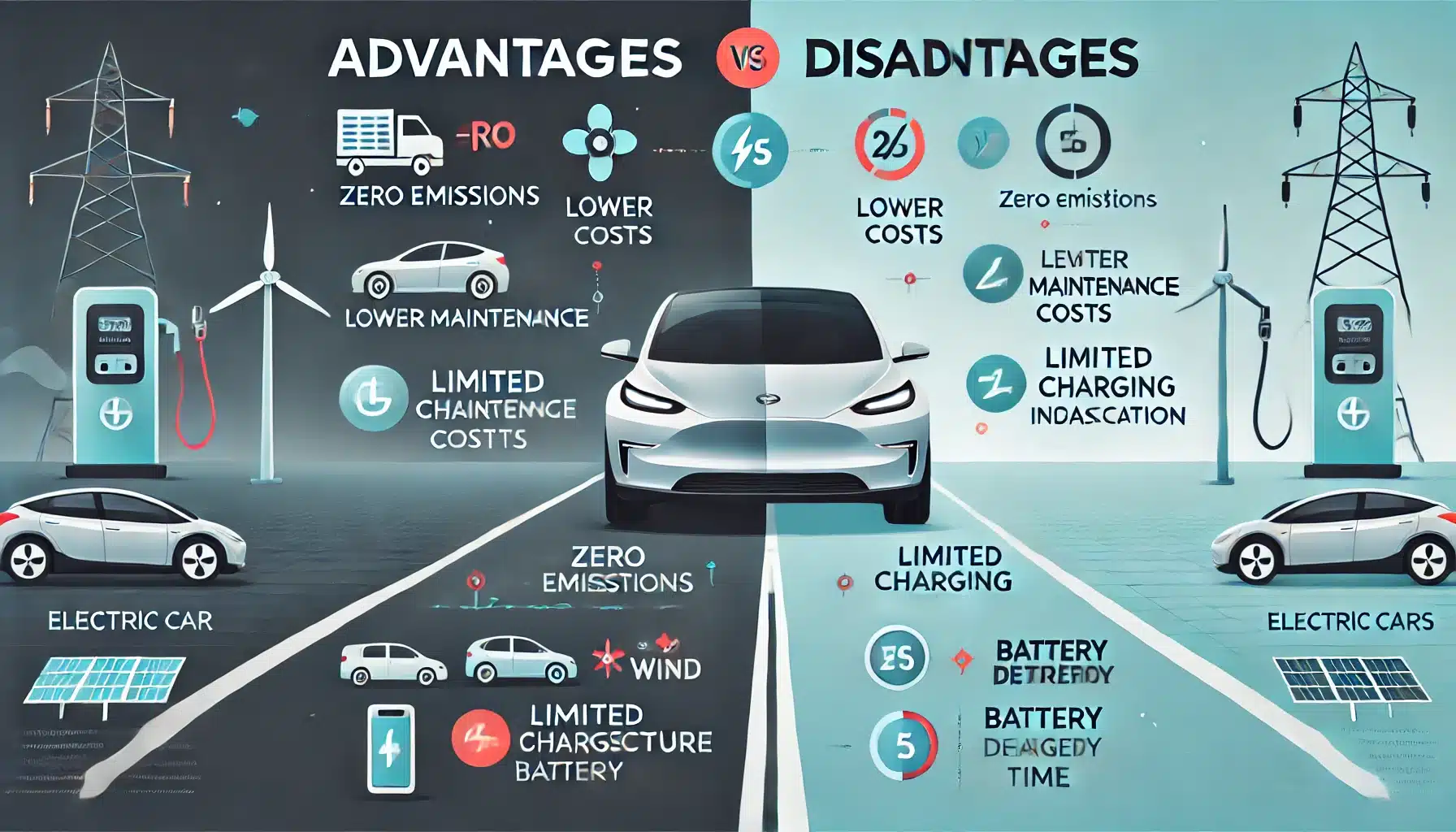
Below is a comprehensive analysis of the advantages and disadvantages of electric cars (EVs). These points reflect the current state of EV technology, market availability, and consumer experiences. They are expected to continue evolving as technology and infrastructure improve.
Advantages
Resource and Supply Chain Concerns
Rare Earth Metals: The materials used in the batteries of electric vehicles include lithium, cobalt, and nickel. Mining and processing of these may bring environmental and ethical issues.
Manufacturing Footprint: Although EVs emit significantly less from the tailpipe, their production process, which includes the making of the battery, can still be a source of carbon emissions if driven by fossil fuels.
Balancing the Pros and Cons
Cost vs. Savings: Electric vehicles may be initially more expensive, but they can still bring a lot of savings in the long run with respect to fuel and maintenance. State subsidies can also act as a bridge over the initial expenses.
Range and Infrastructure Progress: Normally, the following generation of an electric vehicle brand comes with a longer range and charging stations are available in more and more places. The charging field is continuously evolving and hence, charging is becoming less time-consuming.
Technology Evolution: Most of the money that is spent globally is on battery research and therefore, demands such as energy density, charging time, and costs will be resolved which in turn will increase the overall demand for EVs.
Environmental Considerations: The main thing that puts advantages ahead of costs is that by eliminating direct emissions from vehicles and providing clean energy from renewables to the grid, the ecological benefits of the electric car become larger.
Conclusion
In terms of lesser emissions, lower running costs, and overall better performance, electric vehicles have quite a few advantages. However, issues such as the initial cost, limited range, and battery sustainability, as well as the existence of charging facilities, are still present. Gradually, government support, battery technology improvement, and more extensively developed charging networks are solving these problems. Actually, when technological progress reaches a certain point and economies of scale come into play, electric vehicles will probably be an increasingly green and feasible choice for a larger number of consumers.
Environmental Benefits
Reduced Emissions: Electric vehicles (EVs) are the cleanest (zero emissions) mode as they emit no pollutants from their tailpipe. Thus, they are major contributors to the reduction of carbon emissions and so, they have the potential to improve the quality of the local air (especially in cities) a lot.
Energy Efficiency: EVs are still the most energy-efficient ones, which cannot be done by internal combustion engines (ICEVs). This is because most of the electric energy that is being drawn from the grid is directly used for the wheels.
Potential for Clean Energy Integration: The overall carbon footprint can be much less than that of a gasoline or diesel vehicle if the necessary charging for the EV is done by electricity from 100% renewable sources (solar, wind, hydro).
Lower Operating Costs
Cheaper Fuel: Most of the time, electricity is cheaper than gasoline or diesel on a per-mile basis. The savings vary for each region and electricity tariff, but they are quite significant during the vehicle’s entire life span most of the time.
Reduced Maintenance: Electric-powered vehicles are so different that they have few parts that move against each other (there is no engine oil, less fluids, there is no exhaust system) and therefore, maintenance and repair operations are very limited. Also, the brake wear is minimized by regenerative braking systems.
Improved Performance
Instant Torque: One of the favorite reasons of electric motors is the fact that the power is given instantaneously and, hence, a fast acceleration is possible. To a certain extent, EVs have been able to bring their 0-60 mph times at the level of sports cars.
Quiet Operation: Electric motors are quiet and thus attract both the user and the environment, more than ever before, by a significant noise pollution reduction that is typical of the urban areas.
Government Incentives
Tax Credits and Rebates: Various governments offer financial incentives in the form of tax credits, rebates, and reduced registration fees to support EV adoption.
Access to Restricted Areas and Perks: Some privileges are given to EV drivers, e.g. the possibility of free or cheap parking, less payment at toll booths, and the right to use lanes that are reserved for vehicles with a high number of passengers (HOV).
Technological Growth and Innovation
Continuous Advancements: The evolution of battery technology is so fast that batteries become longer-lasting, are recharged faster, and prices go down with time.
Software Upgrades: Internet updates can be applied to some EVs, making them more efficient in performance, giving them new features, or allowing the battery to be made longer without the need to go to the service station.
Disadvantages
Higher Upfront Cost
Purchase Price: Theoretically, the initial purchase price of a number of electric vehicles can still be higher than that of a similar internal combustion vehicle, even if the running costs are lower.
Battery Expense: The battery pack of an electric vehicle is the element that contributes the most to the overall cost. Although the battery price is going down, it still accounts for a large part of the total vehicle price.
Limited Range (Compared to ICEVs)
Range Anxiety: Some consumers may be worried about the possibility of running out of energy, especially if they are taking long trips. As of now, most electric vehicles have a range of 200-300 miles per charge, and in some cases, even more. However, the gas-powered car may still have a longer range than the EV.
Cold Weather Effects: It is known that the ranges of EVs can be reduced in extreme weather conditions as more battery heating or cooling will be needed.
Charging Infrastructure and Time
Infrastructure Gaps: Even though the work of installing charging points is being sped up, they are still not as many or as easily reachable as gas stations, especially in the countryside or less developed areas.
Longer Refueling Times: Normally, a fast-charging procedure to about 80% capacity takes approximately 20 to 45 minutes and a few minutes is all that are needed if a gasoline car has to be refueled. Besides that, Level 2 home chargers and public chargers may need a few hours to complete a full charge.
Battery Degradation
Limited Lifespan: Each type of batteries gradually loses its capacity over time. A majority of electric vehicles come with a battery warranty (mostly 8 years or 100,000 miles), nevertheless, quite a few will be facing replacement costs if their batteries run out of the warranty period.
Resale Uncertainty: Battery remaining life may be the aspect that potential buyers consider when thinking of purchasing a second-hand EV, therefore, resale values might be affected in some markets.